
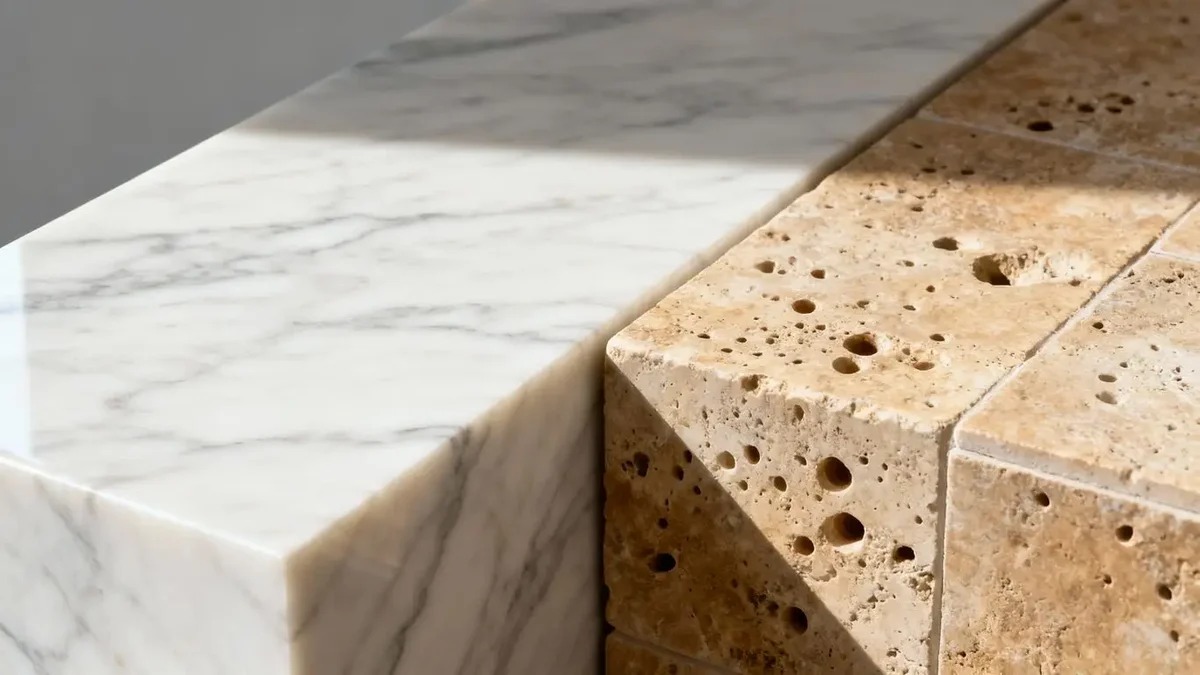
 In the fascinating world of natural stone, the two materials most frequently confused by professional architects and property owners alike, used interchangeably, yet entirely distinct in their structural essence, are undoubtedly travertine and marble. Although both stone components are fundamentally based on calcium carbonate minerals, the millions of years of geological formation processes they undergo deep within or near the earth's crust are completely antithetical to one another. These deeply rooted geological origins directly dictate the stones' machinability from the moment they are quarried, their microscopic surface porosity, their thresholds of resistance against physical impacts, and ultimately, the unique aesthetic perception they project onto architectural spaces. Deciding on the correct natural stone choices for a modern or rustic architectural project does not merely determine the initial visual success of that design; it also directly shapes the structure's centuries-long resilience against severe weather conditions, heavy foot traffic, and chemical agents, making a comprehensive understanding of these differences vital on both an academic and practical level.
When we dive into the birth story of marble, we observe that colossal tectonic movements, unimaginable geothermal heat, and tremendous pressure deep within the earth's crust play the leading roles. The process by which limestone undergoes metamorphism under extremely high temperatures and pressure waves combined with magmatic activity miles beneath the surface is what beautifully creates marble. This intense and highly compacting geological process endows marble with an incredibly tight, interconnected, crystallized, and almost entirely non-porous internal structure at a molecular level. Those mesmerizing veined structures and wide color variations we see on the noble surface of marble are the direct result of iron oxide, silica, clay, and various other minerals seeping between the limestone layers during this billions-of-years-old formation phase and being crushed and blended under extreme pressure. This extraordinarily dense and void-free internal texture is precisely what allows marble to be polished to a mirror-like finish using advanced diamond-tipped machinery in factories, reflecting incoming light seamlessly like a crystal canvas and converting any ray of light into pure luxury. These specific marble properties make the stone highly desirable for projects that aim to evoke an elite sense of history and classic monumentality.
Travertine, on the contrary, does not undergo its formation miles beneath the earth's surface under tectonic compression; instead, it develops in much shallower layers closer to the surface, in basins where hot springs, geothermal riverbeds, and limestone caves are actively situated through a much faster and superficial sedimentary precipitation process. When thermal underground waters, highly supersaturated with calcium bicarbonate, suddenly emerge to the surface, the sharp drop in atmospheric pressure and sudden temperature variance cause the carbon dioxide gas dissolved in the water to rapidly escape into the air. During this rapid outgassing, calcium carbonate minerals precipitate in successive layers on the basin floors, hardening over time to form travertine rocks, while the carbon dioxide gas bubbles escaping from the water leave behind characteristic microscopic and macroscopic voids, channels, and spongy chambers within the stone's body. This naturally porous structure, born from the very heart of wild nature along with its prominent sedimentary bedding planes, is the single greatest visual and physical distinguishing characteristic that sets travertine apart from classic marble. These internal structural systems are known universally as defining travertine properties, allowing the stone to naturally breathe and absorb environmental stress.
When evaluating these two stones in terms of the atmosphere and visual perception they create within architectural spaces, marble projects a classic, smooth, sharp, and royal sense of luxury descending from historical palaces, whereas travertine offers a Mediterranean-inspired, rustic, warm, timeless, and completely organic aesthetic realm. While marble boasts an expansive color spectrum ranging from the purest whites to the deepest blacks, greens, and ivories, complemented by bold, contrasting vein movements; travertine concentrates heavily on warm earthy tones such as ivory, cream, beige, walnut, noce, gold, and tan, effortlessly infusing the soothing and welcoming warmth of nature into any environment. Architects weighing their decisions based on the soul of the space will turn to the majesty of polished marble if they are targeting an ultra-modern design with sharp lines and radiant grandeur; however, for projects that seek a living, breathing, soothing, and welcoming home feeling or carry the philosophy of an ancient Roman villa, the scale always tips toward the unparalleled texture of travertine. In modern interior architecture, this ongoing structural debate is often summarized through the industry term travertine vs marble, guiding clients toward the ideal choice for their bespoke living spaces.
When examining physical strength, abrasion resistance, and structural durability, the dense crystalline structure of marble, compressed under immense geological pressure, positions it as slightly more resistant to surface scratches, friction, heavy weight loads, and sudden impacts compared to travertine. However, this engineering fact should never create a false perception that travertine is an unstable or brittle material; indeed, monumental ancient structures still standing in all their glory today, such as the Colosseum in Rome and St. Peter's Basilica in the Vatican, are living testaments to the magnificent lifespan of travertine against harsh environmental elements. Furthermore, thanks to its naturally porous and voided matrix, travertine possesses microscopic elasticity thresholds; this allows it to behave much more flexibly against thermal shocks—namely, drastic night-and-day or summer-and-winter temperature fluctuations—substantially reducing the risk of internal pressure cracks, proving itself globally as an incredibly durable natural stone choice for exterior paving.
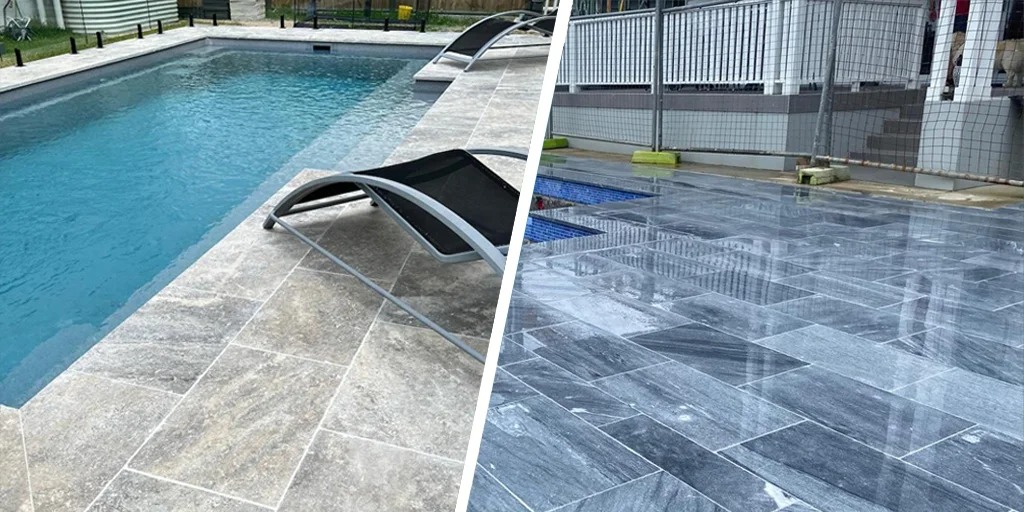
The performance and safety standards exhibited by these two stones vary quite dramatically when applied to wet areas, swimming pool decks, terraces, and outdoor floors exposed to heavy precipitation. Because marble is highly susceptible to receiving a mirror polish and lacks surface porosity, it tends to create a surface as slippery as an ice rink at the slightest contact with water or rain, which poses significant safety hazards in outdoor applications. Travertine, on the other hand, when processed through factory finishes such as tumbling, brushing, or being left in its natural unfilled state, effectively prevents water from accumulating and forming a slippery film due to its natural micro-pores, ensuring excellent traction and high slip resistance even when walked on with wet feet. In addition to this vital safety advantage, travertine possesses a remarkably low thermal conductivity coefficient; meaning that even under the most scorching summer sun, it will not absorb heat and reach skin-burning temperatures like marble or concrete, consistently offering a cool, comfortable paving area. This unique performance matrix makes it one of the premier flooring materials recommended by architects for high-end open-air architecture.
 In interior design, marble preserves its centuries-old leadership and popularity across sprawling living room floors, monolithic kitchen countertops, luxury hotel lobbies, and opulent bathroom wall claddings due to its bright, light-reflective surface that effortlessly visually expands a room. This innate ability of marble to absorb and bounce light back serves as a brilliant spatial trick for interior designers, instantly making dim or confined spaces appear significantly more grand, luminous, and airy. Travertine, conversely, is preferred in interior designs for localized yet high-impact focal points; such as massive living room fireplace surrounds, three-dimensional split-face stone accent walls behind television units, and rustic bathrooms utilizing filled honed surface treatments. When integrated into an interior layout, travertine successfully breaks the occasionally cold, palace-like atmosphere of polished marble, welcoming anyone who steps into the room with an intimate, cozy, authentic, and nature-connected feeling. For interior architects planning private residential layouts, selecting the correct type of interior stones ensures that public spaces like entryways and lounges look exceptionally layered and inviting.
From the standpoint of maintenance, cleaning protocols, and long-term sustainability, both natural stones share a mutual point of vulnerability due to their calcium-based composition, which is their low tolerance toward acidic substances. Although cleaning non-porous marble may seem more straightforward at first glance, everyday household acids like lemon juice, vinegar, or acidic cosmetics can etch the polished surface of marble within seconds, leaving dull, unsightly marks that can easily absorb deeper into the stone. The distinctive surface pores of travertine, when intended for interior flooring applications, are sealed at the factory using specialized cementitious or epoxy-based fillers matching the stone’s native coloration to ensure a smooth, easily cleanable surface. For both stones to preserve their initial grandeur for generations, pH-neutral soaps must always be preferred over aggressive chemical cleaners, and penetrating surface sealers that safeguard the stone’s matrix against staining should be reapplied at regular intervals.
When exploring cost analysis and project budget planning, the fact that marble deposits are located much deeper within the earth's crust and that extracting uncracked, large blocks presents a major logistical and technological challenge generally positions its market pricing in a higher luxury bracket than travertine. Particularly rare white marble selections featuring sought-after vein characteristics can command premium prices reserved for custom-budget zones of ultra-luxury projects, whereas travertine can be sourced at much more optimized and accessible costs, especially in a geography like Turkey, which hosts the world's most abundant and premium-quality travertine reserves. Naturally, travertine materials also encompass a wide pricing and luxury spectrum of their own based on block criteria, color homogeneity, custom factory dimensioning craftsmanship, and advanced cutting orientations like vein cutting; however, in comprehensive architectural applications, travertine consistently delivers an exceptional price-to-performance ratio.
In conclusion, if your architectural vision and dream project call for a modern, seamless, radiant, and regal line of elegance, you should choose the timeless world of polished marble; but if you desire a character that stems from the very heart of nature—warm, organic, defying time, and adapting flawlessly to both interior and exterior environments—you should opt for the spellbinding texture of travertine. At Vision Travertine, we meticulously extract the most premium, homogeneous, and high-quality selections of both stones from our very own quarries, processing them to world-class standards in our state-of-the-art facilities to inject immense value into your architectural endeavors. It must always be remembered that there is no absolute right or wrong in natural stone selection; the ultimate stone is the one that responds most flawlessly to the physical conditions, climate variables, traffic density, and personal aesthetic expectations of your unique architectural space.